In the drama "A Streetcar Named Desire" by Tennessee Williams, the sisters Blanche and Stella are both victims. The reader can see that Stella is a victim much more easily than they can see Blanche because of the abuse she goes through from Stanley. Once Blanche moved in with her and Stanley, Stella became even more of a victim. Blanche continuously criticized Stella's appearance, marriage, and social status. Even when Stella tried to stick up for her sister, Stanley put her down for being so gullible, or avoiding the fact that Blanche had lied all along. Stella is a victim of not only her sister and husband, but she is also a victim of herself. She could have stayed at Belle Reve to marry a rich man, or she could have believed Stanley from the start and kicked Blanche out of the house the first time she could. Stella is a victim of being too caring. She cared for Stanley, because she was having a baby and for his sexual appeal; she cared for Blanche because they're sisters and she loved taking care of her.
Blanche's life has been much more complicated than Stella's in the fact that she had to stay home and go through so much grief in losing her family, her home, and her dignity. Blanche is a victim of her past, which made her a victim of her present and future. She was so traumatized by her first husband's betrayal with another man that she had to prove to herself that she attracted men by sleeping with as many as she could. When she finally found someone she wanted to be with, her past kept her relationship with Mitch to continue. When she told Stella that she had been raped by Stanley, her lies again caught up with her which lead to her being put into an insane asylum.
Both Stella and Blanche are victims in "A Streetcar Named Desire." Stella, for being to caring and gullible, and Blanche for being too careless with herself and her words.
Sunday, March 15, 2009

Sunday, March 8, 2009
Blanche = Pure?
In "A Streetcar Named Desire," Tennessee Williams first portrays Blanche as a delicate 'southern belle' from a high classed society that has taken a leave of absence because of her "nerves." However, as you read further into the play, you begin to see a different dimension to Blanche. She's not just a person who is freeloading off of her sister and acting like she's better than everyone. She has had a difficult past as well.
Blanche lost her first love while a teenager. He shot himself in the head because she said that he disgusted her while polka music was playing. When she was with Mitch after her birthday 'party,' he told her he didn't want to marry her and the same polka music played.
Blanche went through everyone in her family dying and having to go through with all the funerals and not being able to pay for them, resulting in the loss of their home "Belle Reve." Blanche has just been trying to find a place in her life where she doesn't have to worry about money, or losing anyone she loves. When she witnesses Stanley abusing her sister, she is worried that he will take her away, just as everyone else she's loved has been taken away. Right now, Blanche is confused about who she is, so she puts on an act to hide her emotions and troubles.
Blanche lost her first love while a teenager. He shot himself in the head because she said that he disgusted her while polka music was playing. When she was with Mitch after her birthday 'party,' he told her he didn't want to marry her and the same polka music played.
Blanche went through everyone in her family dying and having to go through with all the funerals and not being able to pay for them, resulting in the loss of their home "Belle Reve." Blanche has just been trying to find a place in her life where she doesn't have to worry about money, or losing anyone she loves. When she witnesses Stanley abusing her sister, she is worried that he will take her away, just as everyone else she's loved has been taken away. Right now, Blanche is confused about who she is, so she puts on an act to hide her emotions and troubles.
Saturday, February 28, 2009
Araby's Paralysis and Epiphany.
In James Joyce's "Araby," the main character is in love with his friend's sister. She tells him that she wants to go to Araby for the bazaar, but is unable to because of a retreat in her church's convent. The boy decides to go for her, and tells her he will get her something. It is at the bazaar, that the boy has paralysis and an epiphany.
The boy waited in anticipation for his trip to Araby. When he finally arrives, he goes to a shop and sees a young lady flirting with two young gentlemen. He finds out that the young lady works in the shop and asked him if he wanted to buy anything in a "voice [that] was not encouraging." He realizes that the young lady has no interest in selling the boy anything, so the boy leaves without purchasing anything. This is where he has his paralysis because he is unable to buy the girl anything. This paralysis also displays the fact that the boy is paralyzed from loving the girl.
Soon after, the lights go out and the boy is left standing there with his eyes filled "with anguish and anger." This is where the boy gets his epiphany. He thought that going to Araby was going to bring him closer to the girl, but after hearing the young lady flirt with the young gentlemen, he realizes that the girl doesn't love him. He now knows that buying her something won't make her love him the way he loves her. The way that the girl spoke of the bazaar made it sound so enchanted to the boy that he just had to go there to impress her, but it ended up being an illusion.
This paralysis and epiphany the boy goes through happens in Joyce's "Eveline" as well. Thinking of her mother's life, Eveline has an epiphany to go away with her boyfriend Frank in order to escape her father's abusive behavior. However, right when she is about to board the boat with Frank, she is paralyzed. Eveline is paralyzed because she realizes that she has to stay home and take care of the house and her father, even if he is abusive. She made a promise to her mother that she would maintain their home as long as she could.
Both the boy in "Araby" and Eveline realized that they cannot love who they thought they were in love with at the time. The boy realizes that the girl he was in love with didn't love her back. Eveline realizes that even if her father doesn't love her, she made a promise to her mother that she would take care of him.
The boy waited in anticipation for his trip to Araby. When he finally arrives, he goes to a shop and sees a young lady flirting with two young gentlemen. He finds out that the young lady works in the shop and asked him if he wanted to buy anything in a "voice [that] was not encouraging." He realizes that the young lady has no interest in selling the boy anything, so the boy leaves without purchasing anything. This is where he has his paralysis because he is unable to buy the girl anything. This paralysis also displays the fact that the boy is paralyzed from loving the girl.
Soon after, the lights go out and the boy is left standing there with his eyes filled "with anguish and anger." This is where the boy gets his epiphany. He thought that going to Araby was going to bring him closer to the girl, but after hearing the young lady flirt with the young gentlemen, he realizes that the girl doesn't love him. He now knows that buying her something won't make her love him the way he loves her. The way that the girl spoke of the bazaar made it sound so enchanted to the boy that he just had to go there to impress her, but it ended up being an illusion.
This paralysis and epiphany the boy goes through happens in Joyce's "Eveline" as well. Thinking of her mother's life, Eveline has an epiphany to go away with her boyfriend Frank in order to escape her father's abusive behavior. However, right when she is about to board the boat with Frank, she is paralyzed. Eveline is paralyzed because she realizes that she has to stay home and take care of the house and her father, even if he is abusive. She made a promise to her mother that she would maintain their home as long as she could.
Both the boy in "Araby" and Eveline realized that they cannot love who they thought they were in love with at the time. The boy realizes that the girl he was in love with didn't love her back. Eveline realizes that even if her father doesn't love her, she made a promise to her mother that she would take care of him.
Wednesday, February 25, 2009
Facebook?!

Miss Emily's Facebook page has very little information. She only has three friends, Colonel Sartoris, Homer Barron (both who haven't signed on in a while) and her servant Tobe. Miss Emily has only one photo, a silhouette of her face through a window; the only image anyone outside her home ever sees. Her privacy settings don't allow anyone to see any of her pictures or personal information. Her status is "engaged to Homer Barron" and has been that way for months. Her wall consists of old conversations with Colonel Sartoris, and Homer Barron, and a few recent ones with Tobe. Miss Emily's Facebook page has no applications or games that would clutter her page.
Colonel Sartoris: You are exempt from paying taxes because of what your father did for our town.
Miss Emily: Thank you Colonel.
(...years later)
Miss Emily: Colonel Sartoris, a man came by my home and told me I had to pay taxes, tell them at once that I have no taxes in Jefferson!
Miss Emily: Tobe, buy some bread for Homer and I.
Tobe: Yes'm.
Miss Emily: Remember not to mention ANYTHING to anyone when you go outside the house.
Tobe: Yes'm.
Miss Emily: Homer! Where have you gone off to? My cousins are now gone for good. Please come home!
Homer Barron: I will come home as soon as I'm done with my meeting in the Elk's Club.
Miss Emily: Good, don't you ever leave again.
Miss Emily's Facebook page is very private, because she doesn't want anyone to know what she has been doing inside her home. She has only one very old picture so no one knows what she looks like today. Miss Emily has hundreds of friend requests, but declines them all to keep her life private. Not much is known about Miss Emily Grierson, and she likes it that way. The only people she is (or was) in contact with, besides Tobe, are dead. Miss Emily does not like to socialize with others because she is the last of her generation and does not wish to socialize with people she did not grow up with. The only sources of information about Miss Emily the public gets is of gossip. Rumors are passed from person to person, slightly changing every time it is passed, which make them unreliable and others very curious.
Sunday, February 22, 2009
Fact or Fiction?
In Franz Kafka's "The Metamorphosis, Gregor Samsa awakes one morning and "[finds] himself transformed in his bed into a gigantic insect." During the past five years, all Gregor has done is wake up, get on a train, and go to work, every single day. This routine has made his life quite monotonous, similar to a bug's life. Gregor doesn't do anything out of the ordinary and all his family cares about is the money he brings home. When he transforms into a bug, Gregor's routine finally comes to a stop. Now that he can no longer go to work, his family believes that Gregor is now useless and has become a liability.
The descriptions of Gregor's appearance after his transformation are so unique to a bug's appearance that it had to have actually happened. The description of "his domelike brown belly divided into stiff arched segments" and "his numerous legs" that "waved helplessly before his eyes" are things that describe a bug and nothing else. Gregor felt comfortable hiding under the couch and crawling on the walls and ceiling where he was unable to be squashed. Also, the fact that Gregor's father had the instinct to "lift his feet uncommonly high" as if to try to step on him like anyone would try to kill a bug on the floor. The charwoman even referred to Gregor as an "old dung beetle" whenever she went into his room.
The fact that Gregor's life was so monotonous caused him to transform into a bug. Kafka tries to inform people to have variety in their lives, or else their routines will end in a miserable life. All of the descriptions and Gregor's new habits allow the reader to believe that Gregor has indeed turned into a bug.
The descriptions of Gregor's appearance after his transformation are so unique to a bug's appearance that it had to have actually happened. The description of "his domelike brown belly divided into stiff arched segments" and "his numerous legs" that "waved helplessly before his eyes" are things that describe a bug and nothing else. Gregor felt comfortable hiding under the couch and crawling on the walls and ceiling where he was unable to be squashed. Also, the fact that Gregor's father had the instinct to "lift his feet uncommonly high" as if to try to step on him like anyone would try to kill a bug on the floor. The charwoman even referred to Gregor as an "old dung beetle" whenever she went into his room.
The fact that Gregor's life was so monotonous caused him to transform into a bug. Kafka tries to inform people to have variety in their lives, or else their routines will end in a miserable life. All of the descriptions and Gregor's new habits allow the reader to believe that Gregor has indeed turned into a bug.
Monday, February 16, 2009
What if You Turned Into an Insect?
In "The Metamorphosis," Franz Kafka writes of a man, Gregor Samsa, who wakes up one morning transformed into an insect. Shocked of his transformation, Gregor goes back to sleep thinking he will wake up and everything will be back to normal. Instead, he wakes up late for work and still an insect. Worried about Gregor, his family calls for him to get out of bed. Gregor's response sounds far from human, causing them to call for a doctor. When his family finally sees him, they don't know how to react. His mother looks away, and his father aggressively pushes Gregor back into his room. Grete, Gregor's sister, was the only one who even attempted to help. She brought him food and water twice a day, while their parents stayed away.
Since Gregor was the only one in the family that had a job before his "metamorphosis," his father had to get a job for the first time in five years. His parents went on in life as if Gregor had died. Two weeks after his change, his mother finally gets the courage to enter Gregor's room to help Grete move his furniture. Once she sees him, she faints. When his father comes home, and hears about what has happened, he immediately goes after Gregor while throwing apples at him. After finally injuring Gregor with an apple, his mother begged his father to spare his life.
Gregor's parents kept him in his room so no one would know that he'd been transformed. When their cook quit, she promised not to tell anyone of the situation. The uniqueness of their situation kept them from asking for help. Grete and her mother felt sympathy for Gregor, trying to make him feel as comfortable as possible by moving his furniture so he could crawl around until he turned back into a human. However, his father felt that Gregor's transformation meant trouble and that he should be destroyed. They did not question why the transformation happened, or how. They acted as if it never happened and went on with life without him.
Gregor turned into an insect because his life was like an insect's. Not only did he only live to work, he had no social life with anyone in his family. Both his mother and sister showed some affection for Gregor after his metamorphosis, but his father showed absolutely none. Gregor actually talked to his sister before his metamorphosis and had dreams of her becoming a violinist. His mother obviously had the motherly instinct of loving and protecting her son, or what used to be her son. Gregor's relationship with his father never had any love or affection. His father only saw Gregor as money, not as a son.
Since Gregor was the only one in the family that had a job before his "metamorphosis," his father had to get a job for the first time in five years. His parents went on in life as if Gregor had died. Two weeks after his change, his mother finally gets the courage to enter Gregor's room to help Grete move his furniture. Once she sees him, she faints. When his father comes home, and hears about what has happened, he immediately goes after Gregor while throwing apples at him. After finally injuring Gregor with an apple, his mother begged his father to spare his life.
Gregor's parents kept him in his room so no one would know that he'd been transformed. When their cook quit, she promised not to tell anyone of the situation. The uniqueness of their situation kept them from asking for help. Grete and her mother felt sympathy for Gregor, trying to make him feel as comfortable as possible by moving his furniture so he could crawl around until he turned back into a human. However, his father felt that Gregor's transformation meant trouble and that he should be destroyed. They did not question why the transformation happened, or how. They acted as if it never happened and went on with life without him.
Gregor turned into an insect because his life was like an insect's. Not only did he only live to work, he had no social life with anyone in his family. Both his mother and sister showed some affection for Gregor after his metamorphosis, but his father showed absolutely none. Gregor actually talked to his sister before his metamorphosis and had dreams of her becoming a violinist. His mother obviously had the motherly instinct of loving and protecting her son, or what used to be her son. Gregor's relationship with his father never had any love or affection. His father only saw Gregor as money, not as a son.
Wednesday, February 11, 2009
Hawthorne's Religious Views.
In "Young Goodman Brown," Nathaniel Hawthorne depicts a man who is running away from his faith. Brown leaves his wife Faith to go on a journey into the forest with an "evil purpose." (Paragraph 8) On this journey, Brown encounters a mysterious man who claims to have known both Brown's father and grandfather. As they walked deeper into the forest, they see Brown's old catechism teacher goody Cloyse who calls this mysterious man "the devil" (Paragraph 30) and yet goes on like she's known him for years. As they walk even further into the forest, they encounter the deacon and minister of Brown's church who seem to be going to a meeting of some sort. There is a fire burning deep into the forest and Brown sees everyone from town, including Faith and goody Cloyse, gathered around it. A dark figure brings Brown and Faith to the top of a rock and prepares for a marriage or baptism for them, but with red water. As Faith is about to receive her baptism, Brown calls for her to "Look up to Heaven, and resist the Wicked One!" (Paragraph 68) Soon after he yells this, Brown is in the forest, not knowing whether his encounter was a dream or reality. When he goes back home, he sees everyone in a darker light. Brown goes on with his life and dies an old man whose "dying hour was gloom." (Paragraph 72)
In "Young Goodman Brown," allegory and symbolism play a large role in Hawthorne's views on religion. Goodman Brown has a test of faith where he encounters "the devil." All the townspeople seem to know him and be okay with the fact that he's the devil. Brown, however, goes against the devil and all the townspeople by refusing to see his wife convert to the devil's side and telling her to "Look up to Heaven." (Paragraph 68) Nathaniel Hawthorne sees religion as something you have to believe in, and not have any concrete facts to tell you to believe in it. Brown believes in his faith even though he sees everyone else converting to the devil's side. Goodman Brown feels his wife start to lose her innocence by losing her "pink ribbons" (Paragraph 70) and his catechism teacher lose her credibility by being associated with the devil. However, Brown's "dying hour was gloom." (Paragraph 72) Brown refused to side with the devil, and everyone else did. Everyone else was able to sin and have all these vices where Brown couldn't. He just sees everyone else as sinners and himself as pure. Hawthorne sees religion as what you make of it. People sin and still remain faithful to their religion, so you don't have to be completely pure in order to have faith.
In "Young Goodman Brown," allegory and symbolism play a large role in Hawthorne's views on religion. Goodman Brown has a test of faith where he encounters "the devil." All the townspeople seem to know him and be okay with the fact that he's the devil. Brown, however, goes against the devil and all the townspeople by refusing to see his wife convert to the devil's side and telling her to "Look up to Heaven." (Paragraph 68) Nathaniel Hawthorne sees religion as something you have to believe in, and not have any concrete facts to tell you to believe in it. Brown believes in his faith even though he sees everyone else converting to the devil's side. Goodman Brown feels his wife start to lose her innocence by losing her "pink ribbons" (Paragraph 70) and his catechism teacher lose her credibility by being associated with the devil. However, Brown's "dying hour was gloom." (Paragraph 72) Brown refused to side with the devil, and everyone else did. Everyone else was able to sin and have all these vices where Brown couldn't. He just sees everyone else as sinners and himself as pure. Hawthorne sees religion as what you make of it. People sin and still remain faithful to their religion, so you don't have to be completely pure in order to have faith.
Thursday, January 29, 2009
This is just a painting
My wife is
painted beautifully
she treated everyone
with the same smile
my commands
made her smiling
stop
so suddenly
I can
always find another
to be
my next duchess
The poem that I have written is an interpretation of Robert Browning's "My Last Duchess." The form is exactly like William Carlos Williams' "This Is Just to Say" with the number of words, capital letters and lack of punctuation. The sarcasm is also similar to that of Williams', however with a more serious situation. "This Is Just to Say" is merely about a plum being eaten, where my rewrite of "My Last Duchess" is about his wife's death. Williams' poem is more humorous and my poem is much more serious and shocking.
In my poem, the Duke is mocking his late wife by saying that he "can/ always find another" and if she doesn't please him, he'll again find another. It is easy to connect the poems "My Last Duchess" with my rewrite because of the content and the last line being "my next duchess."
painted beautifully
she treated everyone
with the same smile
my commands
made her smiling
stop
so suddenly
I can
always find another
to be
my next duchess
The poem that I have written is an interpretation of Robert Browning's "My Last Duchess." The form is exactly like William Carlos Williams' "This Is Just to Say" with the number of words, capital letters and lack of punctuation. The sarcasm is also similar to that of Williams', however with a more serious situation. "This Is Just to Say" is merely about a plum being eaten, where my rewrite of "My Last Duchess" is about his wife's death. Williams' poem is more humorous and my poem is much more serious and shocking.
In my poem, the Duke is mocking his late wife by saying that he "can/ always find another" and if she doesn't please him, he'll again find another. It is easy to connect the poems "My Last Duchess" with my rewrite because of the content and the last line being "my next duchess."
Monday, January 26, 2009
Not my words.
Ode on a Grecian Urn - John Keats
Stanza II:
Ah, happy, happy boughs! that cannot shed
Your leaves, nor ever bid the Spring adieu;
And, happy melodist, unweariéd,
For ever piping songs for ever new;
More happy love! more happy, happy love!
For ever warm and still to be enjoyed,
For ever panting, and for ever young;
All breathing human passion far above,
That leaves a heart high-sorrowful and cloyed,
A burning forehead, and a parching tongue.
Keats' "Ode on a Grecian Urn" is a balance between the flux of human experience and the fixity of art, the contrast between enduring art and ephemeral art, and an equation between realism and aestheticism. The indefinite article in the poem refers to how Keats did not refer to any single work of Greek art; but to art in general. First of all, when one starts to read this poem, one cannot help but think that the tone is one of happiness. In fact, in the third stanza, Keats uses the word happy five times. The language of the poem is very flowery and beautiful, and it has the effect of lightening the deeper mood of the poem. This stanza recapitulates ideas from the preceding two stanzas and re-introduces some figures, the trees which can't shed leaves, the musician, and the lover. Keats portrays the ideal life on the urn as one without disappointment and suffering. The urn-depicted passion may be human, but it is also "all breathing passion far above" because it is unchanging. He explores the idea that mortal love is something that after the initial passion vanishes, leaves only a "burning forehead and a parching tongue." Keats tries to free himself from the world of change by identifying with the urn, representing art. Death was a part of his own life – people enter and leave all the time; was highly aware of vicissitudes of life and therefore tried to write poetry with exactly the opposite an everlasting passion: what he and other people long for.
Stanza II:
Ah, happy, happy boughs! that cannot shed
Your leaves, nor ever bid the Spring adieu;
And, happy melodist, unweariéd,
For ever piping songs for ever new;
More happy love! more happy, happy love!
For ever warm and still to be enjoyed,
For ever panting, and for ever young;
All breathing human passion far above,
That leaves a heart high-sorrowful and cloyed,
A burning forehead, and a parching tongue.
Keats' "Ode on a Grecian Urn" is a balance between the flux of human experience and the fixity of art, the contrast between enduring art and ephemeral art, and an equation between realism and aestheticism. The indefinite article in the poem refers to how Keats did not refer to any single work of Greek art; but to art in general. First of all, when one starts to read this poem, one cannot help but think that the tone is one of happiness. In fact, in the third stanza, Keats uses the word happy five times. The language of the poem is very flowery and beautiful, and it has the effect of lightening the deeper mood of the poem. This stanza recapitulates ideas from the preceding two stanzas and re-introduces some figures, the trees which can't shed leaves, the musician, and the lover. Keats portrays the ideal life on the urn as one without disappointment and suffering. The urn-depicted passion may be human, but it is also "all breathing passion far above" because it is unchanging. He explores the idea that mortal love is something that after the initial passion vanishes, leaves only a "burning forehead and a parching tongue." Keats tries to free himself from the world of change by identifying with the urn, representing art. Death was a part of his own life – people enter and leave all the time; was highly aware of vicissitudes of life and therefore tried to write poetry with exactly the opposite an everlasting passion: what he and other people long for.
Monday, January 19, 2009
A Picture is Worth a Thousand Words.
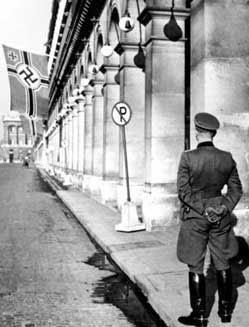
In the poem "Daddy," author Sylvia Plath describes her father, whom she was afraid of while growing up. In stanza 2, Plath states that she "had to kill" her father, but he died before she got the chance. In stanza's 4-10, Plath's father is described as a German Nazi, and Plath herself, described as a "Jew." Stanza 12 gives another person that Plath is angry at; the “black man who / Bit my pretty red heart in two.” In stanza 13, she says how she "tried to die" to get back to her father but failed to do so. By the last stanza, Plath's words are full of anger, calling her father a "bastard" and saying how "the villagers never liked" him.
The image I have chosen is of a German Nazi in an empty street, in black and white.
In the poem, Plath compares the way her father treated (or mistreated) her with the way that Nazi's treated the Jews. Plath tells the reader how she was never able to speak to her father like a Jew is never able to speak to a Nazi. During the Holocaust, the Nazi's were very overpowering and aggressive towards the Jews, as was "Daddy" to Plath. This is a very powerful metaphor considering the amount of deaths the Nazi's caused. The empty street is the absence of the Jews, or the absence of Plath. The black and white of the images refers to the recurrence of the word “black” in the poem. She wrote of a “black shoe,” a “blackboard,” a “black man,” a “man in black,” a “black telephone,” and a “black heart.” The recurring “black” theme gives the reader an image of anger and death. Her entire life is seen in black; her home, her love, everything is depicted as black.
Sylvia Plath’s life is ruined by the way her father raised her. She not only blames him for abusing her, but for not communicating with her. By not having a good male figure growing up, she is not able to handle a relationship with the man who “bit [her] pretty red heart in two.” This is similar to the way Jews were treated by the Nazi’s during the Holocaust. Because of the harmful treatment they got, the survivors of that horrible time were never the same. Their whole lives were messed up because of the way they were treated for several years, just like Plath.
Sunday, January 11, 2009
Poetic Form
Sonnet 73
"That time of year thou mayst in me behold
When yellow leaves, or none, or few, do hang
Upon those boughs which shake against the cold,
Bare ruined choirs where late the sweet birds sang."
It is that time of year
When leaves are yellow and no longer hang on tree branches,
Branches that shake in the cold
In the empty church, the birds no longer sing.
The first quatrain of Sonnet 73 has both obvious and hidden meanings. The obvious meanings are stated in the paraphrased version, but it is unclear whether the writer is trying to say anything more than just the obvious. The way that Shakespeare writes this sonnet, the reader is able to get a hint of a deeper meaning. Each line can have two or more separate meanings. The feeling of growing older and death is present. The leaves falling can represent someone's hair falling and the branches shaking can represent someone growing old and shivering. The only thing that is stated in the paraphrase is the time of year. Poetic form allows the writer to convey countless meanings in this case only ten syllables per line. The paraphrased version needs many more lines in order to support the meaning of what Shakespeare is able to support in only four.
To understand an entire poem, you must understand the first few lines. If you misinterpret one word in the beginning, the meaning of the whole poem can be misconstrued. The first quatrain of the poem leads into even more speak of dying or fading in the next two quatrains. Shakespeare sees sleeping and night as a form of death. He also sees fire as the ultimate suicide because a fire kills itself with the ashes. The multiple mentions of death and dying lead to the couplet at the end of the poem. Here is where the whole poem comes together. Shakespeare reveals that he is speaking of someone he loves more and more now that he or she is growing old. The meaning of the poem is to love as much as you can now, or you may never get the chance again because death is just a moment away.
"That time of year thou mayst in me behold
When yellow leaves, or none, or few, do hang
Upon those boughs which shake against the cold,
Bare ruined choirs where late the sweet birds sang."
It is that time of year
When leaves are yellow and no longer hang on tree branches,
Branches that shake in the cold
In the empty church, the birds no longer sing.
The first quatrain of Sonnet 73 has both obvious and hidden meanings. The obvious meanings are stated in the paraphrased version, but it is unclear whether the writer is trying to say anything more than just the obvious. The way that Shakespeare writes this sonnet, the reader is able to get a hint of a deeper meaning. Each line can have two or more separate meanings. The feeling of growing older and death is present. The leaves falling can represent someone's hair falling and the branches shaking can represent someone growing old and shivering. The only thing that is stated in the paraphrase is the time of year. Poetic form allows the writer to convey countless meanings in this case only ten syllables per line. The paraphrased version needs many more lines in order to support the meaning of what Shakespeare is able to support in only four.
To understand an entire poem, you must understand the first few lines. If you misinterpret one word in the beginning, the meaning of the whole poem can be misconstrued. The first quatrain of the poem leads into even more speak of dying or fading in the next two quatrains. Shakespeare sees sleeping and night as a form of death. He also sees fire as the ultimate suicide because a fire kills itself with the ashes. The multiple mentions of death and dying lead to the couplet at the end of the poem. Here is where the whole poem comes together. Shakespeare reveals that he is speaking of someone he loves more and more now that he or she is growing old. The meaning of the poem is to love as much as you can now, or you may never get the chance again because death is just a moment away.
Monday, January 5, 2009
Subscribe to:
Comments (Atom)