My wife is
painted beautifully
she treated everyone
with the same smile
my commands
made her smiling
stop
so suddenly
I can
always find another
to be
my next duchess
The poem that I have written is an interpretation of Robert Browning's "My Last Duchess." The form is exactly like William Carlos Williams' "This Is Just to Say" with the number of words, capital letters and lack of punctuation. The sarcasm is also similar to that of Williams', however with a more serious situation. "This Is Just to Say" is merely about a plum being eaten, where my rewrite of "My Last Duchess" is about his wife's death. Williams' poem is more humorous and my poem is much more serious and shocking.
In my poem, the Duke is mocking his late wife by saying that he "can/ always find another" and if she doesn't please him, he'll again find another. It is easy to connect the poems "My Last Duchess" with my rewrite because of the content and the last line being "my next duchess."
Thursday, January 29, 2009

Monday, January 26, 2009
Not my words.
Ode on a Grecian Urn - John Keats
Stanza II:
Ah, happy, happy boughs! that cannot shed
Your leaves, nor ever bid the Spring adieu;
And, happy melodist, unweariéd,
For ever piping songs for ever new;
More happy love! more happy, happy love!
For ever warm and still to be enjoyed,
For ever panting, and for ever young;
All breathing human passion far above,
That leaves a heart high-sorrowful and cloyed,
A burning forehead, and a parching tongue.
Keats' "Ode on a Grecian Urn" is a balance between the flux of human experience and the fixity of art, the contrast between enduring art and ephemeral art, and an equation between realism and aestheticism. The indefinite article in the poem refers to how Keats did not refer to any single work of Greek art; but to art in general. First of all, when one starts to read this poem, one cannot help but think that the tone is one of happiness. In fact, in the third stanza, Keats uses the word happy five times. The language of the poem is very flowery and beautiful, and it has the effect of lightening the deeper mood of the poem. This stanza recapitulates ideas from the preceding two stanzas and re-introduces some figures, the trees which can't shed leaves, the musician, and the lover. Keats portrays the ideal life on the urn as one without disappointment and suffering. The urn-depicted passion may be human, but it is also "all breathing passion far above" because it is unchanging. He explores the idea that mortal love is something that after the initial passion vanishes, leaves only a "burning forehead and a parching tongue." Keats tries to free himself from the world of change by identifying with the urn, representing art. Death was a part of his own life – people enter and leave all the time; was highly aware of vicissitudes of life and therefore tried to write poetry with exactly the opposite an everlasting passion: what he and other people long for.
Stanza II:
Ah, happy, happy boughs! that cannot shed
Your leaves, nor ever bid the Spring adieu;
And, happy melodist, unweariéd,
For ever piping songs for ever new;
More happy love! more happy, happy love!
For ever warm and still to be enjoyed,
For ever panting, and for ever young;
All breathing human passion far above,
That leaves a heart high-sorrowful and cloyed,
A burning forehead, and a parching tongue.
Keats' "Ode on a Grecian Urn" is a balance between the flux of human experience and the fixity of art, the contrast between enduring art and ephemeral art, and an equation between realism and aestheticism. The indefinite article in the poem refers to how Keats did not refer to any single work of Greek art; but to art in general. First of all, when one starts to read this poem, one cannot help but think that the tone is one of happiness. In fact, in the third stanza, Keats uses the word happy five times. The language of the poem is very flowery and beautiful, and it has the effect of lightening the deeper mood of the poem. This stanza recapitulates ideas from the preceding two stanzas and re-introduces some figures, the trees which can't shed leaves, the musician, and the lover. Keats portrays the ideal life on the urn as one without disappointment and suffering. The urn-depicted passion may be human, but it is also "all breathing passion far above" because it is unchanging. He explores the idea that mortal love is something that after the initial passion vanishes, leaves only a "burning forehead and a parching tongue." Keats tries to free himself from the world of change by identifying with the urn, representing art. Death was a part of his own life – people enter and leave all the time; was highly aware of vicissitudes of life and therefore tried to write poetry with exactly the opposite an everlasting passion: what he and other people long for.
Monday, January 19, 2009
A Picture is Worth a Thousand Words.
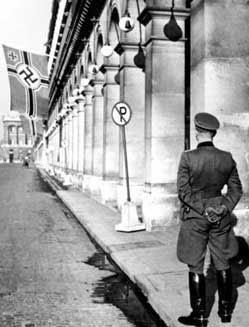
In the poem "Daddy," author Sylvia Plath describes her father, whom she was afraid of while growing up. In stanza 2, Plath states that she "had to kill" her father, but he died before she got the chance. In stanza's 4-10, Plath's father is described as a German Nazi, and Plath herself, described as a "Jew." Stanza 12 gives another person that Plath is angry at; the “black man who / Bit my pretty red heart in two.” In stanza 13, she says how she "tried to die" to get back to her father but failed to do so. By the last stanza, Plath's words are full of anger, calling her father a "bastard" and saying how "the villagers never liked" him.
The image I have chosen is of a German Nazi in an empty street, in black and white.
In the poem, Plath compares the way her father treated (or mistreated) her with the way that Nazi's treated the Jews. Plath tells the reader how she was never able to speak to her father like a Jew is never able to speak to a Nazi. During the Holocaust, the Nazi's were very overpowering and aggressive towards the Jews, as was "Daddy" to Plath. This is a very powerful metaphor considering the amount of deaths the Nazi's caused. The empty street is the absence of the Jews, or the absence of Plath. The black and white of the images refers to the recurrence of the word “black” in the poem. She wrote of a “black shoe,” a “blackboard,” a “black man,” a “man in black,” a “black telephone,” and a “black heart.” The recurring “black” theme gives the reader an image of anger and death. Her entire life is seen in black; her home, her love, everything is depicted as black.
Sylvia Plath’s life is ruined by the way her father raised her. She not only blames him for abusing her, but for not communicating with her. By not having a good male figure growing up, she is not able to handle a relationship with the man who “bit [her] pretty red heart in two.” This is similar to the way Jews were treated by the Nazi’s during the Holocaust. Because of the harmful treatment they got, the survivors of that horrible time were never the same. Their whole lives were messed up because of the way they were treated for several years, just like Plath.
Sunday, January 11, 2009
Poetic Form
Sonnet 73
"That time of year thou mayst in me behold
When yellow leaves, or none, or few, do hang
Upon those boughs which shake against the cold,
Bare ruined choirs where late the sweet birds sang."
It is that time of year
When leaves are yellow and no longer hang on tree branches,
Branches that shake in the cold
In the empty church, the birds no longer sing.
The first quatrain of Sonnet 73 has both obvious and hidden meanings. The obvious meanings are stated in the paraphrased version, but it is unclear whether the writer is trying to say anything more than just the obvious. The way that Shakespeare writes this sonnet, the reader is able to get a hint of a deeper meaning. Each line can have two or more separate meanings. The feeling of growing older and death is present. The leaves falling can represent someone's hair falling and the branches shaking can represent someone growing old and shivering. The only thing that is stated in the paraphrase is the time of year. Poetic form allows the writer to convey countless meanings in this case only ten syllables per line. The paraphrased version needs many more lines in order to support the meaning of what Shakespeare is able to support in only four.
To understand an entire poem, you must understand the first few lines. If you misinterpret one word in the beginning, the meaning of the whole poem can be misconstrued. The first quatrain of the poem leads into even more speak of dying or fading in the next two quatrains. Shakespeare sees sleeping and night as a form of death. He also sees fire as the ultimate suicide because a fire kills itself with the ashes. The multiple mentions of death and dying lead to the couplet at the end of the poem. Here is where the whole poem comes together. Shakespeare reveals that he is speaking of someone he loves more and more now that he or she is growing old. The meaning of the poem is to love as much as you can now, or you may never get the chance again because death is just a moment away.
"That time of year thou mayst in me behold
When yellow leaves, or none, or few, do hang
Upon those boughs which shake against the cold,
Bare ruined choirs where late the sweet birds sang."
It is that time of year
When leaves are yellow and no longer hang on tree branches,
Branches that shake in the cold
In the empty church, the birds no longer sing.
The first quatrain of Sonnet 73 has both obvious and hidden meanings. The obvious meanings are stated in the paraphrased version, but it is unclear whether the writer is trying to say anything more than just the obvious. The way that Shakespeare writes this sonnet, the reader is able to get a hint of a deeper meaning. Each line can have two or more separate meanings. The feeling of growing older and death is present. The leaves falling can represent someone's hair falling and the branches shaking can represent someone growing old and shivering. The only thing that is stated in the paraphrase is the time of year. Poetic form allows the writer to convey countless meanings in this case only ten syllables per line. The paraphrased version needs many more lines in order to support the meaning of what Shakespeare is able to support in only four.
To understand an entire poem, you must understand the first few lines. If you misinterpret one word in the beginning, the meaning of the whole poem can be misconstrued. The first quatrain of the poem leads into even more speak of dying or fading in the next two quatrains. Shakespeare sees sleeping and night as a form of death. He also sees fire as the ultimate suicide because a fire kills itself with the ashes. The multiple mentions of death and dying lead to the couplet at the end of the poem. Here is where the whole poem comes together. Shakespeare reveals that he is speaking of someone he loves more and more now that he or she is growing old. The meaning of the poem is to love as much as you can now, or you may never get the chance again because death is just a moment away.
Monday, January 5, 2009
Subscribe to:
Comments (Atom)